Nov 1, 2025
In anticipation of Medfield’s 375th anniversary celebration in 2026, we have been looking through our archives at past anniversary commemorations. On February 21, 1976, Medfield citizens enjoyed a bicentennial anniversary celebration complete with parade featuring fire trucks from all the neighboring towns, floats representing local groups including our own Historical Society, and no shortage of balloons, souvenirs, period costumes, dance performances and refreshments. The event included an elaborate reenactment of the burning of the town (a replica of early Medfield dwellings) on that date in 1676. This was the year of the American Bicentennial, although it was actually the tricentennial anniversary of the King Philip War. Most of the 1976 event can be viewed today on YouTube.
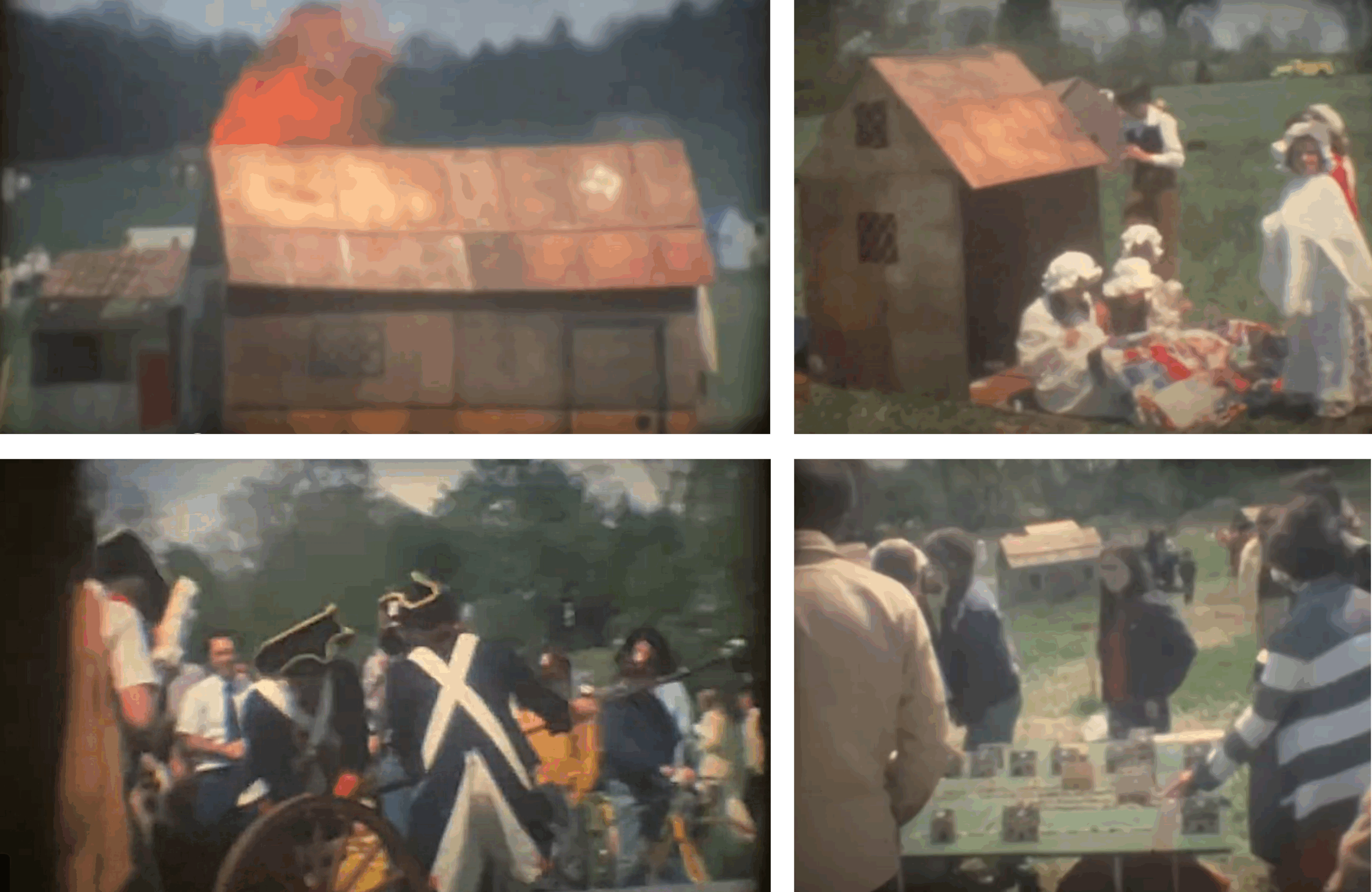
Comparing the footage from 1976 to the record of the 1876 event, I was struck by the dramatic differences in the ways in which the same town told the same story. In 1976, families gathered with children and pets, soaking up the festivities in high spirits reminiscent of today’s Medfield Day celebrations. They are clearly having fun while learning about life in early Medfield, for both the English settlers and the indigenous people, through instructive exhibits provided by costumed volunteers.
The intergenerational participation is notable, with the presence of children in sharp contrast to the very adult version of the celebration in 1876. The quality of the video is not ideal, but we can see children and adults of all ages participating together. As someone who was a teenager during the American Bicentennial of 1976, I am not surprised by the “upbeat” tone of the event. It was a very patriotic time, and for the most part, it felt like people came together as Americans. While viewing the footage, I felt the same Medfield spirit that is still prevalent today: people respecting and honoring our history, while having a heck of a good time in the present.
Turning toward the 1876 Bicentennial, William S. Tilden, author of our beloved History of Medfield 1650-1886, wrote that the event was probably the catalyst for his writing the book: “This book was not undertaken in the hope of pecuniary gain.The interest awakened by the bicentennial celebration of 1876 led many citizens to desire that a more complete memorial of the town might at some future time be prepared” (Tilden 10). Tilden then became the founder and first President of the Medfield Historical Society.
From the Preface of the 1876 commemorative pamphlet:
“The second Centennial Anniversary of this event was anticipated by the present inhabitants with great interest, and as it would occur on this Centennial year of the nation’s life, a desire was universally expressed that it might be marked by a public celebration. Accordingly, a meeting of the citizens was held early in the year for the purpose of taking some action respecting such a celebration. At this meeting, it was voted that the day should be celebrated in a suitable manner. A Committee —consisting of Rev. C. C. Sewall, Rev. J. M. R. Eaton, Jacob R. Cushman, Charles Hamant, and James Hewins, Esquires, — was chosen to make all necessary arrangements for accomplishing the wishes of the people as indicated by their vote.”
The Committee sent invitations to members of state and local government, pastors and ex-pastors of the town, and various dignitaries. The tone of the day was quite literary and far more restrained than in 1976, in keeping with the style of the period. The day began with the ringing of bells and “the firing of a national salute” from the Massachusetts Artillery. We cannot watch the day unfold on our phones, so we can only read the texts of all the speeches, poetry, and tributes delivered on that day. We have in our archive a copy of the original commemorative pamphlet which is also available online, plus a fragile, yellowed copy of the Norfolk County Post’s report (25 February 1876) on the event. The Post coverage reproduces the pamphlet, with some additional observations about Medfield, such as the architecture of the Peak House and the Town Hall, by the anonymous reporter.
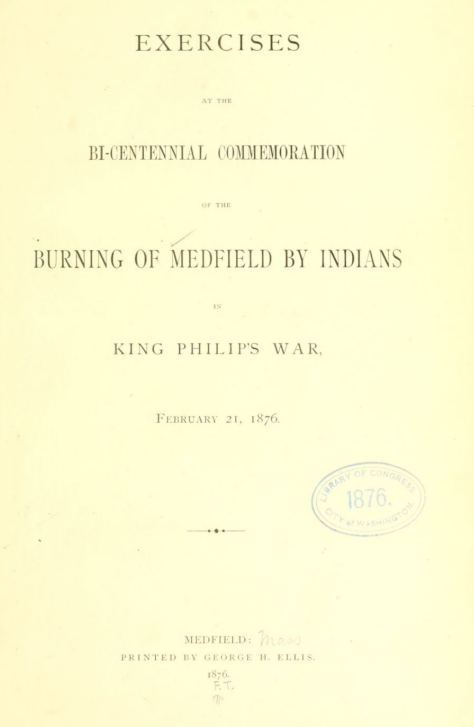 From the pamphlet we have the following description of the day’s commencement:
The Town Hall was finely decorated by Beals & Son, of Boston. Music was furnished by the Medfield Band. The hour appointed for the literary exercises of the occasion was 10:30 A.M. And, at this hour, a crowd had assembled which filled the hall to its utmost capacity. The exercises consisted of an opening address by Rev. C. C. Sewall, President of the day; prayer by Rev. J. M. R. Eaton; hymn sung by the audience in the familiar tune of “St. Martin’s”; address by Robert R. Bishop, Esq., a native of Medfield and now a resident of Newton; music by the band; and a poem by James Hewins, Esq., a citizen of the town.” At this point, “a recess was taken for a collation (lunch) in the vestry of the Unitarian Church. At 2 p.m. the people reassembled in the Town Hall, and the exercises were resumed by the singing of a beautiful hymn written for the occasion by Rev. J. H Allen, of Cambridge.
The afternoon ceremonies proceeded with more speeches by invited guests. After the “President of the Day” proposed a toast to “Mother Dedham”(the response was unenthusiastic), the Rev. Theron Brown of Norwood arose and spoke, attesting to the humanity of King Philip.Rev. Brown’s ancestor John Brown had been a friend to Philip, and thus the Brown family’s lives were spared: “. . .Thus I claim I owe to King Philip’s humanity and forbearance my present place in this land of the living. . .” In the speeches of the several clergymen who addressed the assembled group throughout the daylong event, there is frequent use of the word “savage” to describe both the Indians themselves and the cruelty of the attack, but there is also a touch of acceptance — but only towards those who had been Christianized. Finally the meeting was closed with prayer by Rev. A. M. Crane. In contrast to the more celebratory Bicentennial of 1976, with its Indian costumes and exhibits showing Indian culture and crafts, we can gain a greater understanding of the ways in which a century changes us. To consider the differences in how the same story was told by the same town, 100 years apart, is equally as instructive as the artifacts themselves.