Sep 1, 2025
In Medfield, we are in a period of significant anniversaries. We are coming up on the 250th anniversary of the Declaration of Independence, the 350th anniversary of the action at Medfield during King Philip’s War, and the 375th anniversary of Medfield’s incorporation.
Digging further for anniversaries, we find that exactly 500 years ago, Spanish conquistador Cortes killed the last Aztec emperor, Cuauhtémoc, and exactly 400 years ago, the Dutch settled Manhattan.
In 1725, 300 years ago, Medfield voters approved spending ₤30 for improvements to the “new” meetinghouse that had been built 19 years earlier.
In 1825, Medfield’s schools were funded to the tune of $4,379.34, and eight Medfield residents chipped in a total of $45 toward the construction of the Bunker Hill monument.
In 1925, town voters considered for the first time a new set of controversial rules that represented a sea change for land use in Medfield and many countries all around the world. More on that later.
Farming was still important in Medfield in 1925. In the decades around the turn of the century, E.V. Mitchell built his straw hat factory into the nation’s second largest, sometimes employing over 1,000 people. But after his death in 1917, the business declined until Julius Tofias of Boston came on the scene in 1929 and bought the former Mitchell space for his growing hat business.
Medfield was a quiet town. The town report shows factoids about life in this small farming community in the Roaring [sic] Twenties:
- Animal inspector George Chenery inspected 46 stables, which contained 361 cattle and 301 swine…plus three sheep and one goat.
- The total value of all town-owned buildings was $120,000. School budget: $29,000. Police: $3,500. Fire: $3,000. But a new typewriter for the town clerk cost $80!
- Vital statistics: Marriages: 30. Births: 42. Deaths among Medfield residents: 35, eight of which were over age 80. Deaths at the state hospital: 99.
Factoids from 1924:
- Election results: Coolidge and Dawes (Republican) 618 votes; Davis and Bryan (Democrat) 94.
- Referendum questions – Daylight savings time: 275 in favor, 307 opposed. Allowing women to hold office: 315 in favor, 100 against. Regulating bankers: 274 in favor, 62 against.
- Police budget was $3,000, of which $2,995.76 was spent; $4.24 was returned to the town treasury.
- At high school graduation, senior Gildo Pederzini read his essay on floriculture; for decades thereafter he operated a business at the site which is now Lovell’s.
—
Medfield voters reject Zoning Bylaw in 1925
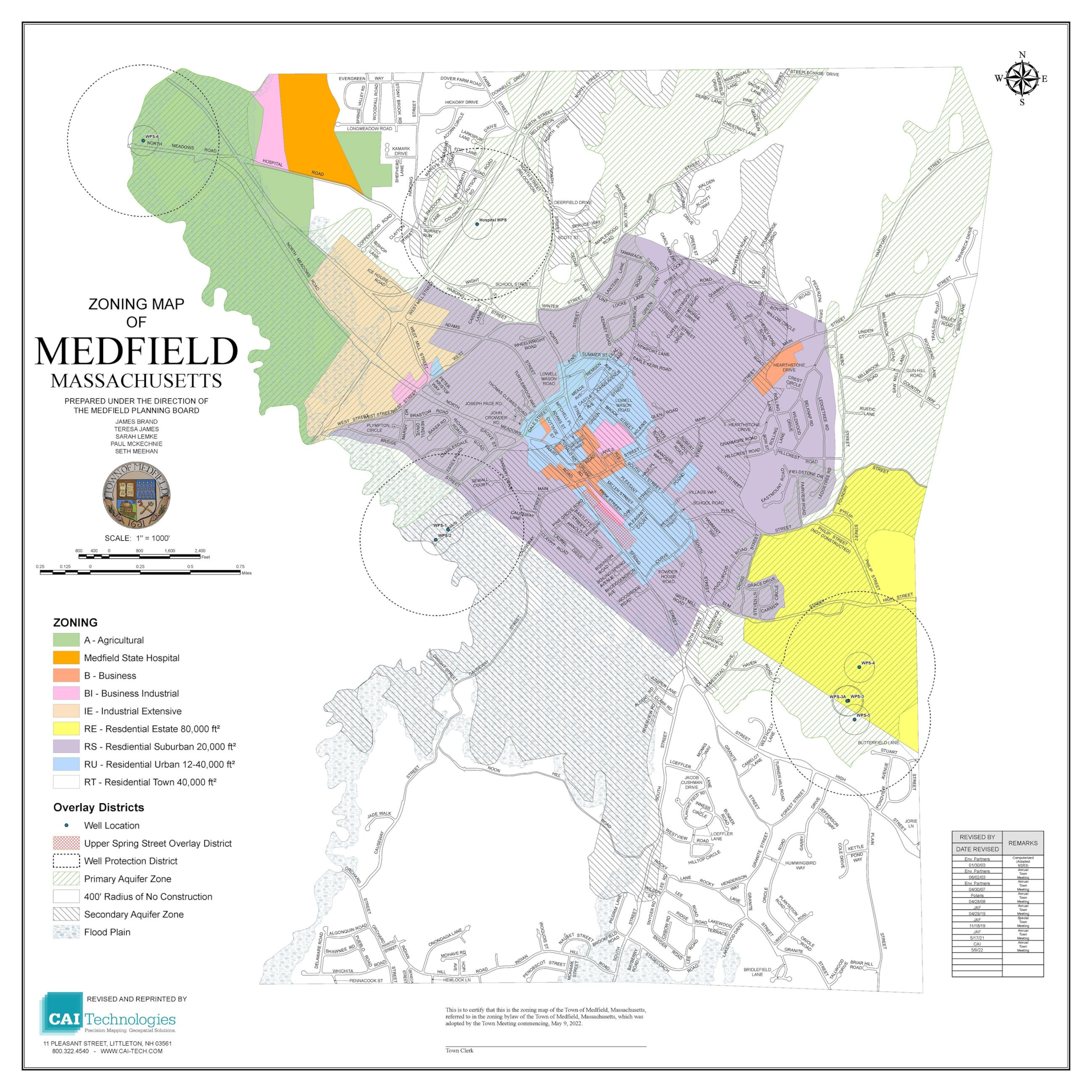
Zoning laws tend to be controversial. Protecting property values is commonly cited as the reason for having them. This seems great if you own property. It’s not so great if you can’t afford to buy it…or if you want to do something with the property that runs afoul if the zoning regulations.
Zoning bylaws first came before Medfield voters at the 1925 annual town meeting. It proposed creating three types of district: residence, business, and manufacturing. Not surprisingly, it was defeated. It was not until 1938 that a compromise bylaw was approved – about the same time when the first building code won acceptance.
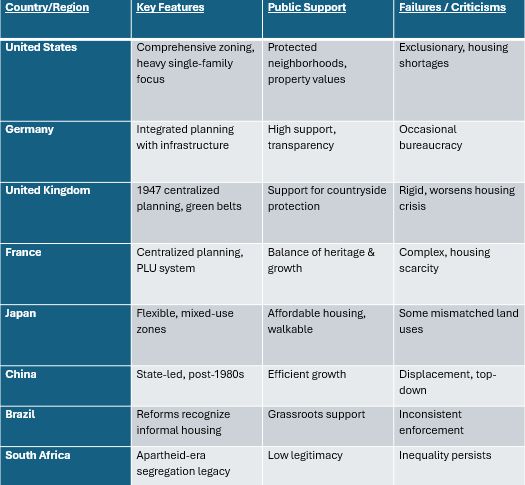
Here, with a tip of the hat to ChatGPT, is a short explanation of zoning laws around the world.
Global History and Outcomes of Zoning Laws
Zoning laws—the rules that regulate how land may be used, built upon, and organized—have shaped cities and societies for over a century. Their history reflects broader struggles between private property rights, public health, economic growth, and social equity. While zoning has provided structure to urban development, it has also provoked debates about fairness, housing affordability, and segregation. Examining the global evolution of zoning shows where laws have enjoyed legitimacy and where they have failed to secure public support.
Early zoning roots came with industrialization. London’s Building Act of 1844 regulated street widths and building dimensions to reduce overcrowding and fire risk. German cities such as Frankfurt and Berlin pioneered systematic zoning to separate housing from heavy industry, measures that earned support for protecting middle-class neighborhoods from pollution.
In the U.S., modern zoning began with New York City’s 1916 Zoning Resolution, dividing the city into districts to control height, density, and land use. This approach gained public support for protecting neighborhoods and property values, and was upheld in 1926 by the Supreme Court in Village of Euclid v. Ambler Realty. Over time, however, U.S. zoning became exclusionary, reinforcing segregation and limiting affordable housing, leading to growing public criticism.
Europe pursued zoning as part of broader planning systems. Germany’s Bauleitplanung earned trust through transparency and integration with infrastructure. The UK’s 1947 Town and Country Planning Act centralized control and preserved green belts, but later drew criticism for rigidity and housing shortages. France combined heritage protection with growth, though its system remains complex and sometimes restrictive.
Japan stands out for its flexible mixed-use zones, allowing residential, commercial, and light industry to coexist. This system has kept housing relatively affordable and supported walkable, dynamic communities, winning broad public support. By contrast, China’s zoning since the 1980s has been highly top-down, channeling growth but generating criticism for displacement, weak citizen participation, and destruction of historic areas.
In Latin America, zoning enforcement has been uneven. São Paulo historically favored elites, but reforms such as Brazil’s Statute of the City (2001) recognized informal settlements, winning grassroots backing despite challenges. In Africa, colonial zoning- imposed segregation, leaving a controversial legacy; post-independence systems often fail to address rapid urbanization and informal growth.
Overall, zoning succeeds where it is flexible, inclusive, and tied to widely valued goals such as health and environmental protection (e.g., Germany, Japan). It fails where it entrenches inequality, affordability crises, or rigid controls (e.g., U.S., UK, South Africa). These lessons remain crucial for cities facing housing pressures, climate change, and growth in the 21st century.
Comparison of Zoning Systems