July 15, 2025
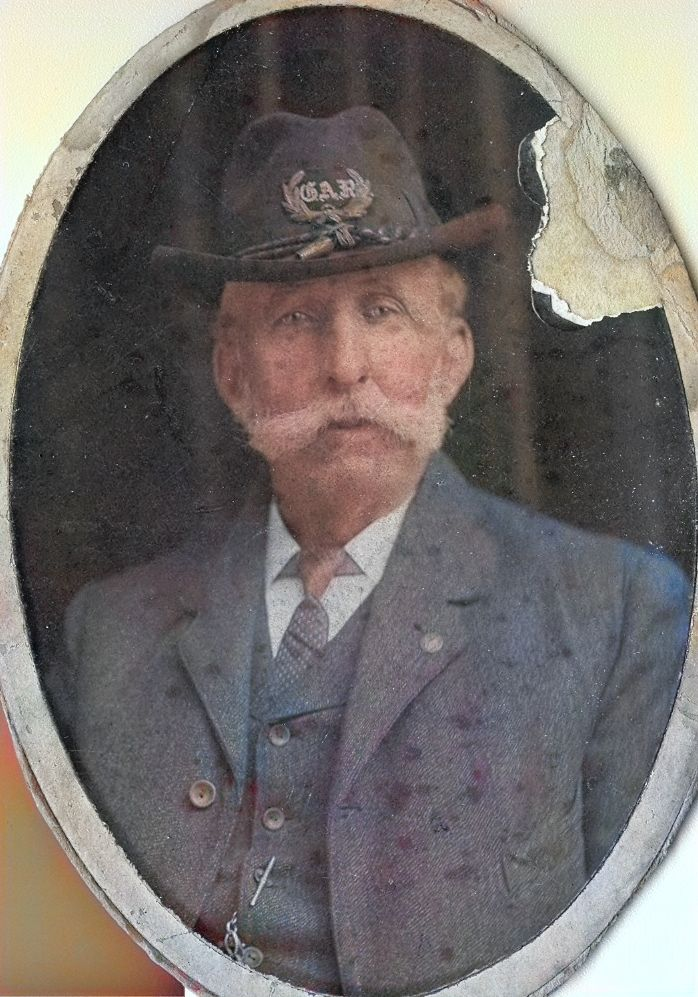
By November 8,1864, Eben G. Babcock was a seasoned soldier, camped in the Shenandoah Valley. He had gotten into and out of a few scrapes; in a previous letter, missing from our collection but referred to in the next letter, he related that he had been caught sleeping on his post.Despite suffering the consequences of this offense, Eben assures Mary he is well and still “enjoying first rate” the army life.
They Won’t Catch Me Again
Dear Mother,
I received 2 letters from you this week, Oct. 28 and Nov. 2. In the last letter you was (sic) worried to death about me because I was in the guard house. They did not do nothing (sic) to me, only kept me in the guard house a week and I did nothing but eat my rations and shovel about an hour a day. Well Sunday morning we had orders to march and we started about 8 o’clock. We marched 12 miles the first day and halted just beyond the last Bull Run battle field and staid there all night then the next day we started again and marched 13 miles through Centerville and Gainesville and New Market and staid there 2 days about 2 miles beyond New Market, 6 1/2 miles near Shenandoah Valley, and here we are. We expect to start again in a day or 2. Am well and fit as a hog and enjoying first rate. We have our rations give (sic) out to us of hard crackers and pork and coffee and sugar. We are allowed 12 crackers a day and 3 quarters of a pound of salt pork and we cook it ourselves and our coffee.
Now don’t worry anymore about my sleeping on my post because I am released and I guess they won’t catch me again. I must fall in now for inspection of arms and must close.
Paid Next Week; Perhaps Start for Home
The last letter in our collection was written “near Washington DC” and is dated May 29, 1865. Eben is getting ready to go home.
Dear Mother,
I will now write you a few lines to let you know I am well although I have received no letter from you since I last wrote. We are in the same camp and expect to get paid this week and perhaps start for home. The company books came last night so it will not take long for to make them out and settle up all our accounts and pay us off. We don’t have much to do now and get pretty good rations too. I have not got the box yet; I don’t know as I will now, before we start for home. Yesterday Gen. Underwood, our old Col. came to see us and very glad was he to see us too. He staid (sic) all day. The regiment turned out to receive him. He said that we had earned a good name to bring home and that we would be received to great reception. There ain’t much news a going now (sic) in camp. Give my love to Father, Annie and all the folks.
There is also an undated letter in the collection, in which Eben told his mother to “go ahead and sell the house,” since “it was a good price.” After several deep and daunting dives into the online databases of the Norfolk County Registry of Deeds, I determined Mary and her husband did sell some land with a building on it, to Caleb S. Hamant, who “owned the house at the corner of South and Philip Streets” and “became a large owner of real estate (Tilden 404).” The records show that Hamant did, indeed, purchase many acres in the southern part of Medfield. The deeds show that farmers in this area owned land that stretched all the way to Granite Street and beyond, near the Walpole line. Property borders shifted but the Babcock family stayed on Pleasant Street in a house that was not yet assigned a number. I regret that I am unable to provide a photograph of the exact house. Pleasant Street itself ended at Oak Street until the street was extended in the late 1880s, and Curve Street laid out, allowing Pleasant Street residents to easily access the world via South and High Streets.
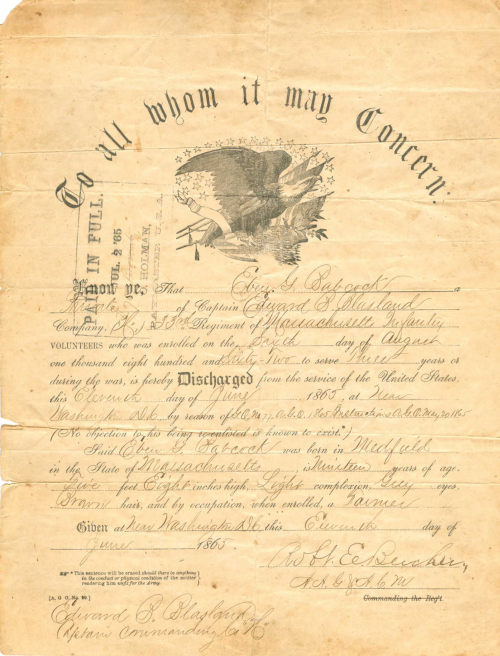
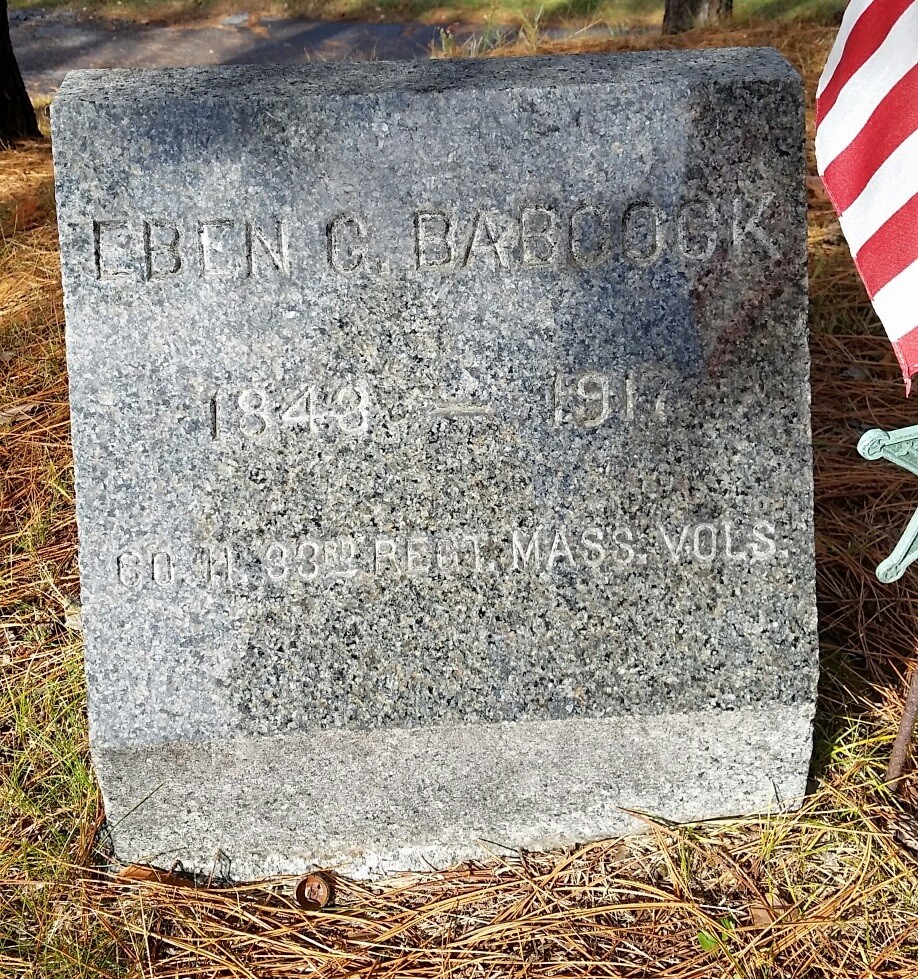
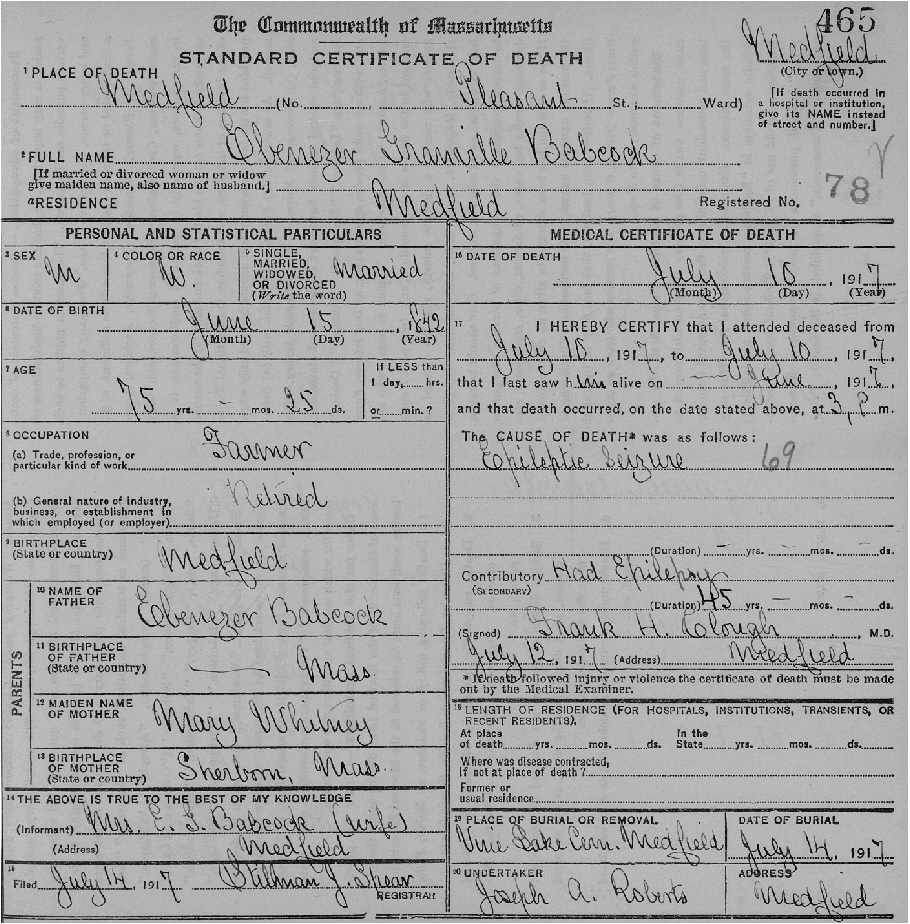
Eben Granville Babcock was honorably discharged on June 11, 1865. He went home to his beloved Medfield, where he returned to farming and remained for the rest of his life. We assume he worked the farm with his father, and took it over some time before the latter’s death in 1876. We know he joined the Moses Ellis Post G.A.R., and by all accounts, lived a quiet and peaceful life. In 1867 Eben married Clara A. Morse of Norfolk. The Babcocks had a son and daughter, George W. Babcock and Mrs. William C. McLeod (Anna). Eben died of epilepsy in 1917 (Incidentally, the death certificate was signed by Stillman J. Spear, the subject of a previous Portal story.)
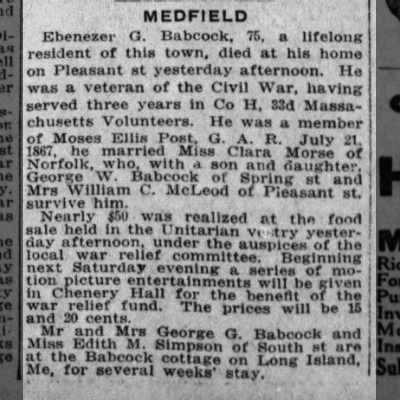
The Dedham Transcript, in the spring of 1935, reported that “Mrs. Clara Babcock, a Civil War widow, is seriously ill at her home on West Main Street.” On April 16 of that year, that newspaper reported on funeral services for Clara, conducted at her home: “Interment was in the family lot in Vine Lake cemetery. Mrs. Babcock, daughter of Jotham and Lydia (Whitney) Morse . . . is survived by two children, George W. Babcock and Mrs. William C. McLeod, four grandchildren and five great-grandchildren. She had been a resident of this town upwards of 66 years and an active member of Medfield Grange as long as her health would permit, and of Moses Ellis Women’s Relief Corps.”
Little sister Annie became Mrs. Giles, and she too lived and died in Medfield. Several generations of Babcocks are buried in Medfield’s Vine Lake Cemetery, which is both simple and remarkable. Descendents of Eben Babcock still live in Medfield. This is a family story of hard-working people with deep ties to one another, and to their hometown.