Nov 1, 2026
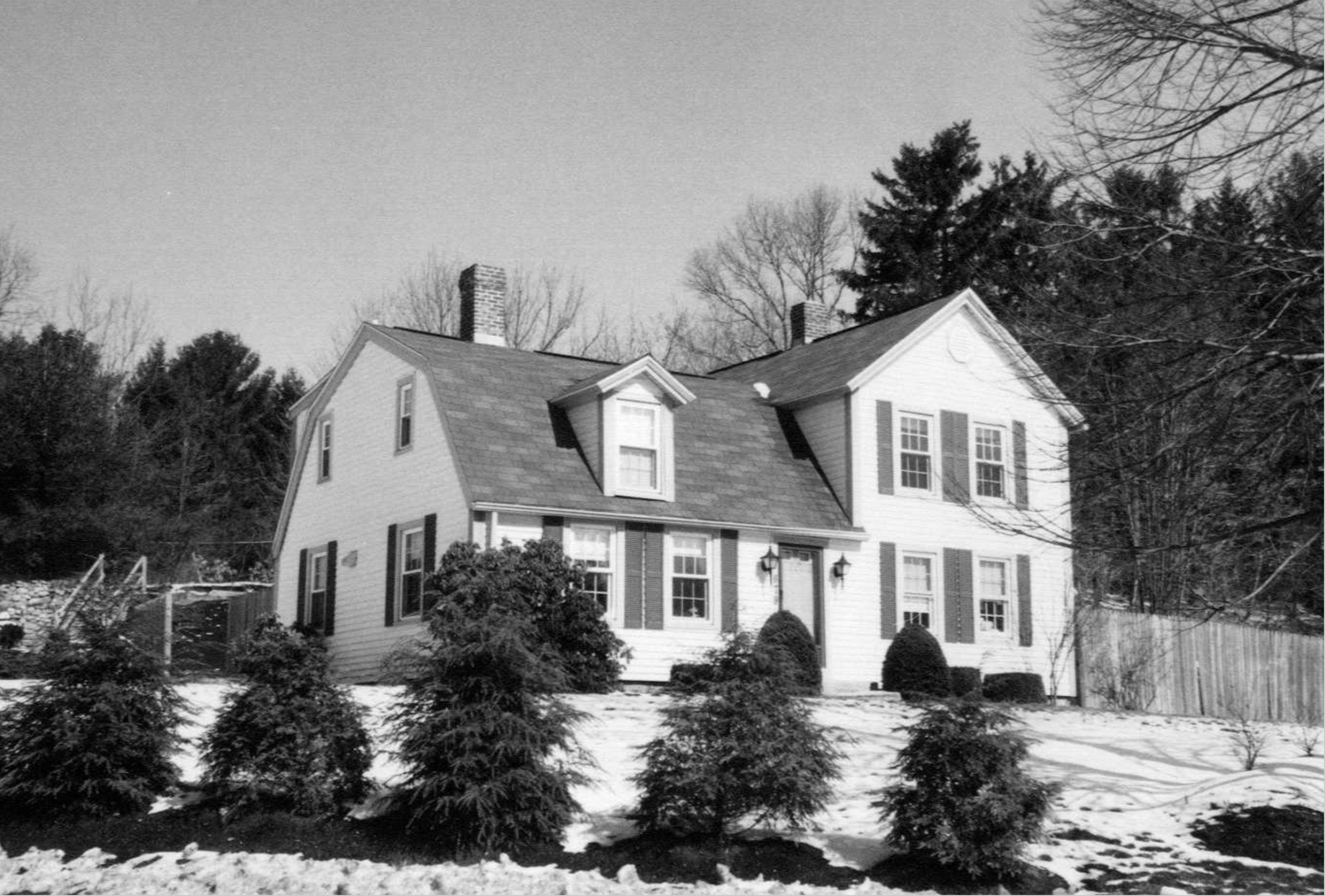 The Samuel Sheppard House stands on Main Street at the corner of Bridge Street. Built circa 1678, this 1½-story home is a gambrel-style colonial, sometimes referred to as a “Dutch Colonial.” That designation is misleading: the Dutch were not among Massachusetts’ early settlers, and gambrel roofs can also be found in early English architecture. In fact, the first gambrel-style house in the American colonies was built in Cambridge in 1677.
The gambrel style is characterized by its distinctive, symmetrical roofline, with a shallow upper slope and a steeper lower slope on each side, maximizing second-floor space. A bonus to this design was that gambrels were technically considered 1½-story houses and were therefore taxed as smaller structures. Like other colonial homes, they typically have a balanced façade, a center chimney, and clapboard siding. This home has seen additions over the years. A second-floor dormer window is centered above the front door, and a large two-story addition was likely built in the late 1800s.
The property was originally granted to John Sheppard of Braintree, who died before he could move to Medfield. Instead, his wife, Margaret, came with her children in 1651, joining other Braintree families who settled in the Bridge Street area. John and Margaret (Squire) Sheppard were born in England and were early settlers of Braintree. Margaret’s sister, Edith, was the wife of Henry Adams, whose sons Jonathan, Edward, Henry, and Peter also came to Medfield with the other Braintree families.
When Margaret died in 1675, her son Samuel inherited the house. Tilden notes that the original house burned in 1676 during King Philip’s War and that Samuel Sheppard rebuilt it. Although there are no early land deed records for the property, Samuel is believed to have sold it sometime in the late 1600s and moved to Mendon, where he died in 1690.
Ownership during the 1700s is unclear, but by 1852, John Kingsbury was living in the home. By 1872, James A. Fairbanks called it home. William Weiker, a farmer and straw worker, purchased the property in 1884, and it remained in the Weiker family for almost 90 years. In 1959, the house passed to William’s son Dana, who lived there until 1968. It remains a private home today.