Sep 1, 2026
The Harding-Fairbanks House sits on Bridge Street, overlooking the Charles River marsh, and is about 270 years old. Old records note that the house has been called Quinobequin, an Algonquian word meaning “meandering” or “wandering,” clearly a reference to the Charles River.
The house is a beautiful example of a center-entry Colonial, with its symmetrical façade. The center front door is Federal style, with sidelights on either side. The front of the house has four large nine-over-six windows, and on the second floor are five smaller six-over-two windows. A large chimney is centered on the roof. Modern updates include a shed dormer on the back roof and a large ell added to the right of the house, with an attached screened porch. The house is clapboarded and has corner boards with decorative tops that give the feeling of Greek columns.
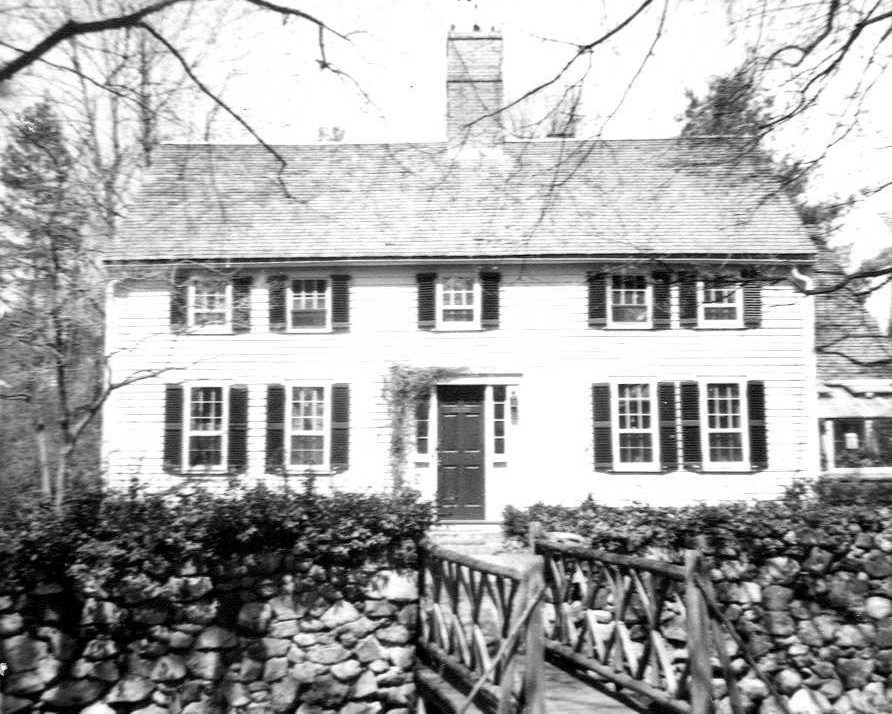
Four acres of land were originally granted in 1651 to Abraham Harding, one of Medfield’s founding fathers. He built his new home here but died just a few years later, in 1655, leaving a widow and four small children. In his will, he bequeathed to his son John, who would have been about ten years old, a double portion of his estate when he reached the age of majority.
A year after Abraham’s death, his widow, Elizabeth, married John Frairy. According to Tilden, Frairy purchased the Harding estate from the heirs in 1665. The Frairy-Harding family lived in the Bridge Street house, where Frairy helped raise the four Harding children. When he died in 1670, he divided his estate among the four Harding children and his two Frairy children. Elizabeth married for a third time, to Thomas Dyer of Weymouth.
The house remained in the family, and in 1676 it was one of the few houses in Medfield that was not burned during King Philip’s War. When Elizabeth died in 1678, she left a will indicating that she still owned, among other parcels of land, her one-third share of the Bridge Street property. She wanted her estate divided evenly among her six children. In 1683, the Harding and Frairy children agreed that Hannah (Frairy) Dyer and Prudence (Frairy) Adams would each receive half of the house.
According to Tilden, when John Harding’s son Henry came of age, he acquired the property on Bridge Street. He married Mary Allen, and together they had five children, although only two daughters, Mary and Thankful, lived to adulthood. In 1749, the Bridge Street home burned to the ground, along with everything in it. The house was rebuilt, and in 1764 Henry left it to his daughter Thankful (Harding) Penniman and her husband, James. When James Penniman died in 1767, it appears the property left the family after almost 120 years.
The deed search gets tricky at the end of the 1700s, but by the 1790s the property was owned by Nathaniel Lovell. He sold it to Charles Wright in 1812, who in turn sold it to Jotham Fairbanks in 1615.
The Fairbanks family lived in the house for the next 65 years. Jotham was a millwright, someone who sets up or repairs machinery. He married Betty Lovell, the daughter of Dyer Lovell, and together they were the parents of five children. Sadly, four of their children died in young adulthood. Their only surviving child, James Addison Fairbanks, became the next owner of the house. James did not remain there long, however, selling the property in 1869.
This house looks almost regal in its placement on the property. Although the Charles River may no longer be easily seen from the front steps, one can imagine the commanding view it once had.