July 21, 2026
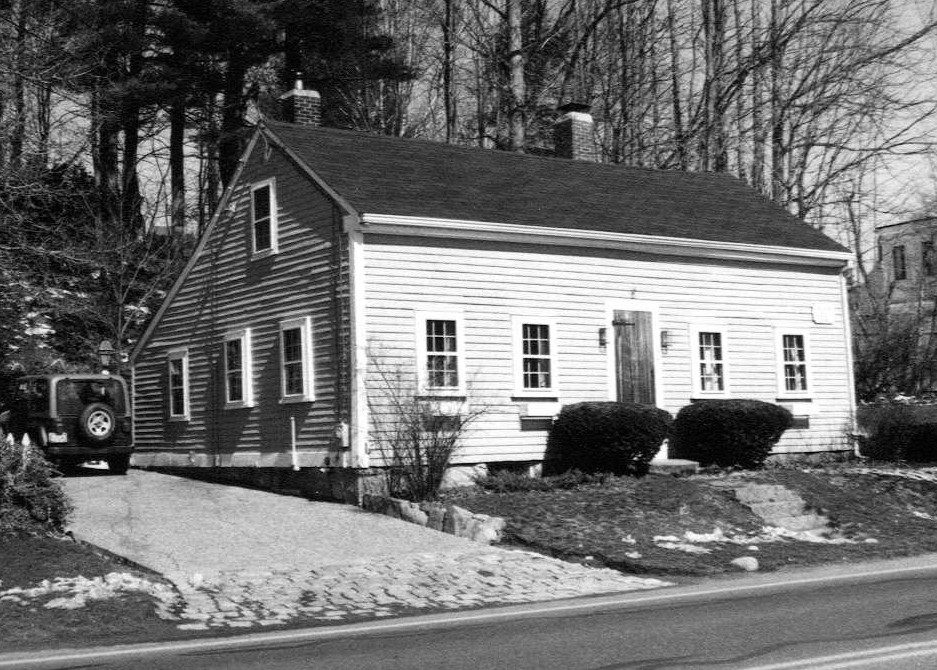
In the summer of 1889, renowned artist Dennis Miller Bunker was summering in Medfield, painting pictures of the town’s bucolic landscapes. His painting *Roadside Cottage* memorializes the Lucy Bran House and is now part of the Museum of Fine Arts, Boston collection.
This house has a long history, and Lucy Bran (1752–1837) is just a small part of that story. It is believed that a portion of the house began as an outbuilding, perhaps a small barn or shed, and may date to the late 1600s. Tracing the land deeds can tell us much about the property’s history and help date the house.
The land was originally granted to Benjamin Wheelock (1640–c.1720) in 1669. He was the son of Ralph Wheelock, one of Medfield’s original thirteen settlers. Benjamin moved to Mendon around 1688, purchasing property there from Mathias Puffer. Although a deed documenting the sale of his Medfield property has not been found, in 1698 Mathias Puffer sold the Wheelock Medfield land to Eleazer Ellis (1664–1731), suggesting that Wheelock and Puffer may have exchanged land. This large parcel stretched from Bridge Street to the cemetery.
The Ellis family owned the property for the next 60 to 100 years, gradually selling off smaller parcels. One such parcel appears to have been sold in 1758, when Benjamin Dunston purchased nine acres with a dwelling house. His only heir, daughter Patience (Dunston) Breck, and her husband sold a 50-acre undivided property in 1798 that included a tenement dwelling house situated between the properties of Adam Peters and Peter Warren to John Baxter and Sabin Mann. Norfolk County deeds show that this parcel changed hands several times during the early 1800s until around 1850, when Prudence (Clark) Lovell purchased it and spent her widowhood there. In the 1870s, Michael Brennan purchased the property from the Lovell estate, and his family owned the home for the next 100 years.
The house is more of a cottage than a farmhouse. It is a small clapboarded 1½-story Cape Cod-style house on a stone foundation. The front features four windows—two on either side of the centered entry door—and a chimney at each end of the house. The rear has a first-floor lean-to addition, giving it the appearance of a small saltbox-style home, with a centered back door and a dormer window on the second floor.
Medfield history notes that the house began life as a “herd house” years before Medfield was settled in 1651. The herd house was used by farmers from Dedham, who brought their cattle to graze in the Charles River meadows. Around 1990, the owners hired an architectural historian from the Society for the Preservation of New England Antiquities (now Historic New England) to inspect and date the house. He agreed that the eastern portion had originally been some type of outbuilding, although likely dating to the early 1700s rather than the 1600s, while the western portion dated to the mid-1700s.
It is believed that Lucy Bran was the first person to live in the house. Her death record states that she was 85 years old when she died in Medfield in 1837, placing her birth around 1752. She was likely born in Natick and came to Medfield as a child in 1758 to live with the Seth Smith family, probably as an indentured servant.
Her parents are unknown, but she may have been the daughter of either Dr. Joshua Brand and Bethiah Prior or Dr. Peter Bran and Sarah Mears. A history of Natick notes that Joshua had a daughter who moved to Medfield and died there in 1837. However, Peter Brand died in 1754 with an insolvent estate. Although his wife inherited her dower third, it was sold after her death in 1798 to satisfy Dr. Brand’s outstanding debts. This financial hardship may have made it difficult for Sarah Brand to support her children and could explain why Lucy was placed in another household.
Lucy rented this home, likely moving in during the late 1770s. She supported herself as a weaver. After her death in 1837, the family of Samuel Green rented the property. By 1850, Prudence (Clark) Lovell had purchased the house and lived there until her death. The Brennan family owned it from 1874 until 1973.
The Lucy Bran House remains an adorable cottage that still stands today as a testament to Medfield’s colonial past and its Revolutionary-era history.